Parents & home · 7 Oct 2026
How to Help Your Child Read in English: A Parents’ Guide
Fifteen minutes a day, the right books and a little patience: how to help your child read in English at home, even if English is their third language.

Our view
Why we believe children should meet grammar in stories, songs and real exchanges first, and what the research really says about explicit teaching.
Picture a Year 3 class. On the board: “Present simple, third person: add -s.” The children copy the rule, fill in ten blanks, and get most of them right. The next day, one of them says: “My brother play football.”
We have seen this scene in classrooms across Morocco for thirty years. It tells us something simple: knowing a rule and using the language are not the same thing. That is why, when it comes to teaching grammar to young learners, our position is clear. Children should meet grammar inside stories, songs and real exchanges first. The rule, if it comes at all, comes later, as a name for something they already do.
The problem
A rule is an abstraction about language. A seven-year-old does not yet think about language as an object to analyse; they think about what they want to say. Give them the rule first, and you ask them to do the hard part before the easy part.
There is also the question of time. Many Moroccan primary schools give English one to three hours a week. Every minute spent explaining a rule is a minute not spent hearing and using English, and young learners have very few other places to hear it.
Finally, there is the Moroccan context. Our pupils already study French grammar for years, with its conjugation tables and rules to learn by heart. When English arrives as a third language, it should not feel like a second grammar course. It should feel like a new way to say things.
That is the heart of implicit grammar teaching: the structure is always there in the lesson, but the child meets it through meaning, many times, before anyone names it.
In class
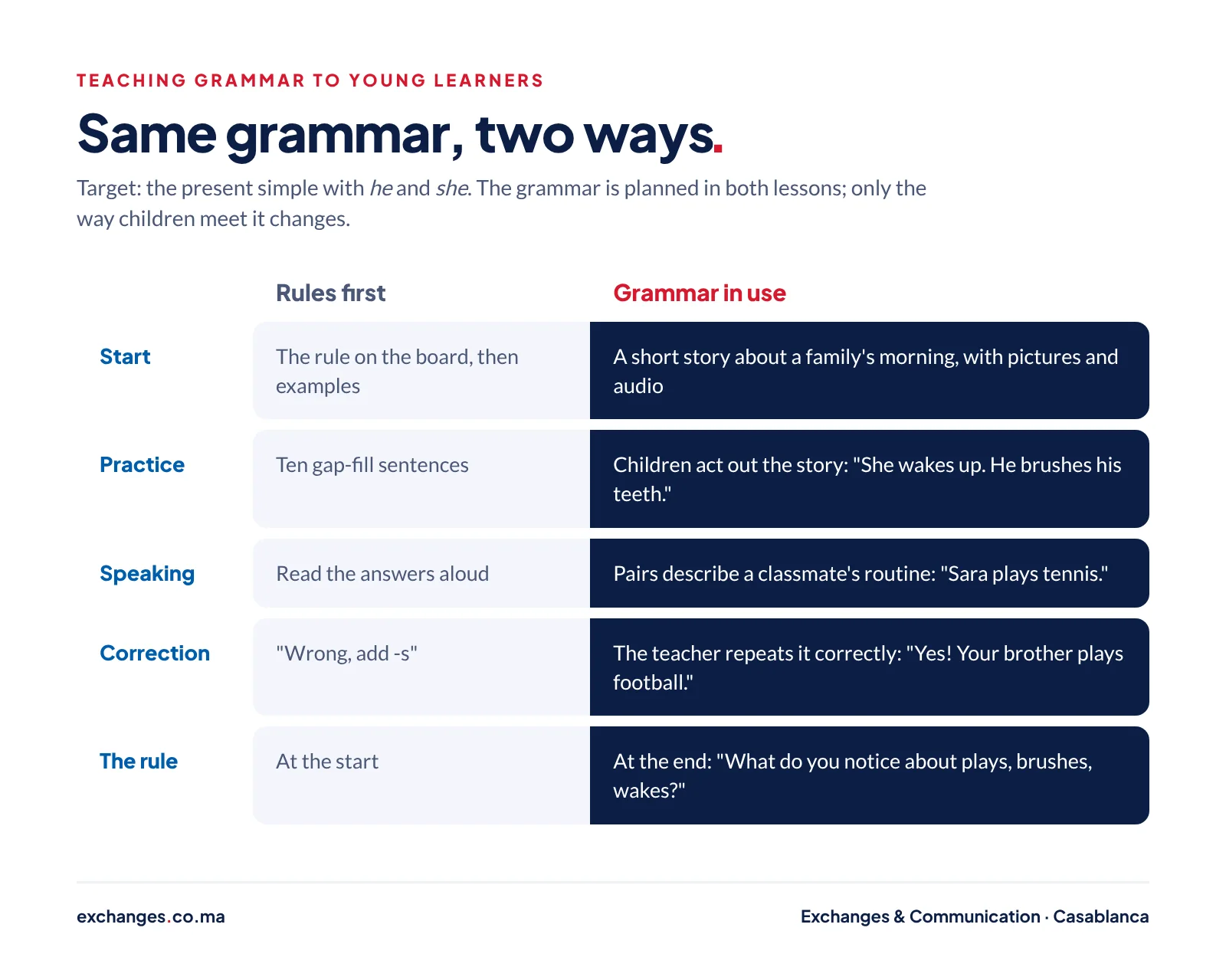
Implicit does not mean accidental. The grammar is planned; only the way children meet it changes. Here is the same target, the present simple with he and she, taught two ways.
| Rules first | Grammar in use | |
|---|---|---|
| Start | The rule on the board, then examples | A short story about a family’s morning, with pictures and audio |
| Practice | Ten gap-fill sentences | Children act out the story: “She wakes up. He brushes his teeth.” |
| Speaking | Read the answers aloud | Pairs describe a classmate’s routine: “Sara plays tennis.” |
| Correction | “Wrong, add -s” | The teacher repeats it back correctly: “Yes! Your brother plays football.” |
| The rule | At the start | At the end, if the class is ready: “What do you notice about plays, brushes, wakes?” |
Five tools make it work in any classroom:
Knowing a rule and using the language are not the same thing.
The research
An opinion is only worth something if it is honest about the evidence, so here it is. Research does not say that explicit grammar teaching is useless.
So our position is not “never mention grammar”. It is about order and dose:
What we reject is the lesson that starts with a rule and ends with a worksheet, and calls that learning English.
For your school
For teachers: plan each lesson around a story, a song or a task, and list the structure it carries in your notes, not on the board. Count how many times each child hears and says it. Correct by recasting, not by stopping.
For coordinators: test what you teach. If lessons are built on use, tests should ask pupils to understand and say things, not to recite rules. A speaking task and a short listening are better evidence than a page of conjugations.
When choosing a coursebook: look for series where grammar is introduced through stories, songs and dialogues, with lots of recycling across units, and where the Teacher’s Book shows how to draw attention to form without a lecture. Most primary courses we distribute, such as Look, Super Minds and Primary Path, are built this way. [Confirm before publishing]
A last word. Grammar matters. Children who never get the structures right will struggle later. But for young learners, the fastest road to correct grammar runs through using English, often and with pleasure, not through talking about it.
Exchanges runs practical trainings on teaching grammar to young learners, on site or online, for schools across Morocco.
For young learners, grammar should be met in use first: stories, songs, dialogues and tasks. The rule comes later, as a name for what pupils already do, with more explicit attention as they grow and prepare for exams. Want to bring this approach to your teachers? Exchanges runs trainings on teaching grammar to young learners, on site or online, for schools across Morocco: see the upcoming trainings.
Opinion of Exchanges & Communication.
Teaching where pupils meet a structure through meaningful use (stories, songs, tasks) many times before the rule is named, if it is named at all.
No. Research finds explicit attention helps learners, children included. The question is order and dose: for young learners, meaning and use should come first.
After pupils have used the structure, and more as they grow older. Exam preparation such as A2 Key or B1 Preliminary benefits from naming and comparing structures.
Parents & home · 7 Oct 2026
Fifteen minutes a day, the right books and a little patience: how to help your child read in English at home, even if English is their third language.