Our view · 19 Nov 2026
Teaching Grammar to Young Learners: Learnt, Not Lectured
Why we believe children should meet grammar in stories, songs and real exchanges first, and what the research really says about explicit teaching.

Parents & home
Fifteen minutes a day, the right books and a little patience: how to help your child read in English at home, even if English is their third language.
If you are wondering how to help your child read in English, you are already ahead. Most children in Morocco meet English after Arabic and French. That sounds like a lot, but it is also a strength: your child already knows that letters stand for sounds, and already reads in at least one other language.
What makes the difference is not a tutor or an app. It is a short, regular habit at home, with books your child enjoys and can almost read alone. This guide shows you how to build that habit, which English books for kids to choose, and how reading fits with school homework.
The research
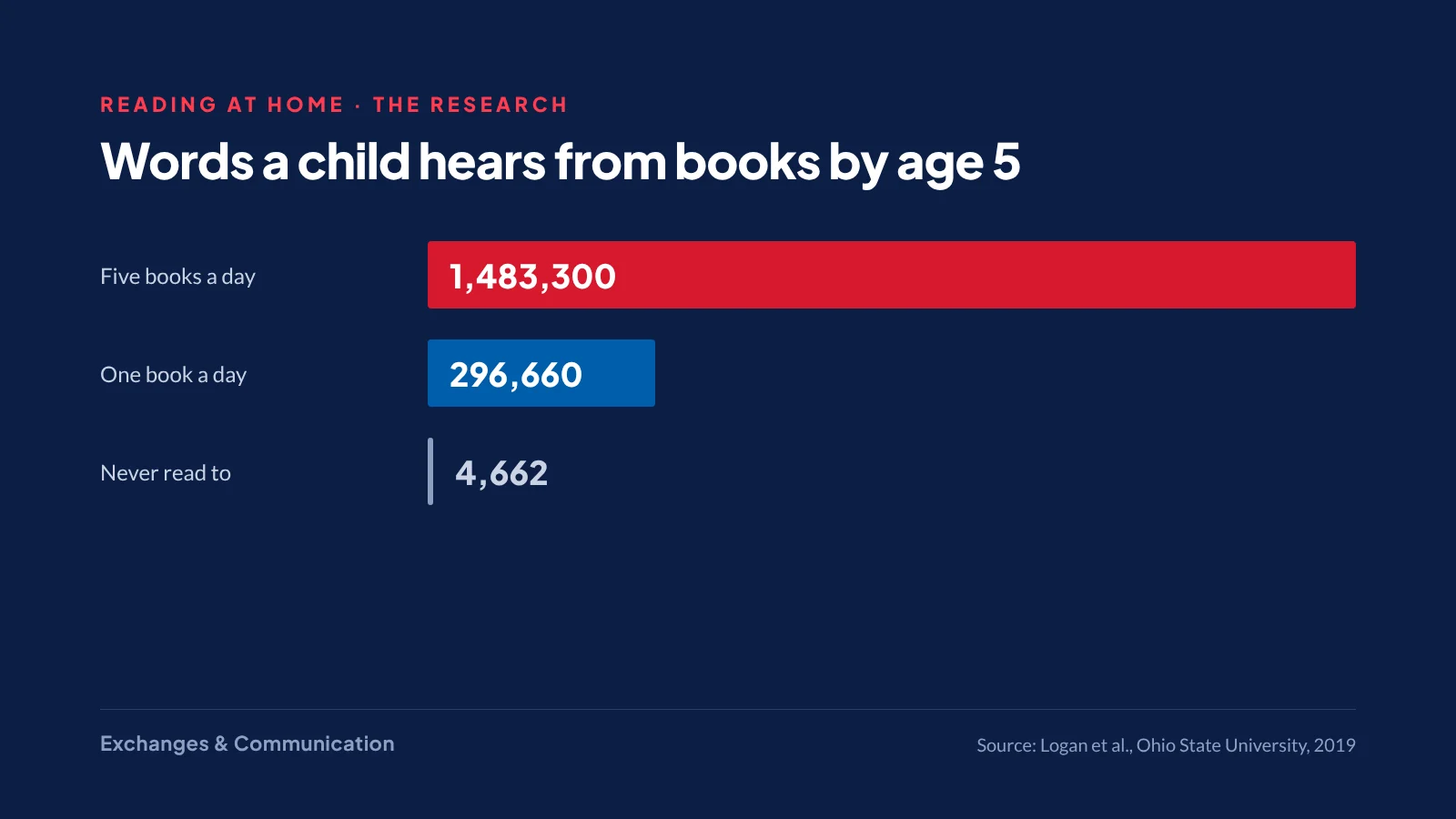
Reading aloud is one of the simplest things a parent can do, and its effect adds up quickly. A 2019 Ohio State University study led by Jessica Logan estimated how many words children hear from books by the age of five.1
These are estimates built from typical children’s books, published in the Journal of Developmental and Behavioral Pediatrics. The point for parents is simple: even one book a day gives a child far more words than conversation alone.
Books also bring words that everyday talk does not. Research on picture books suggests their text offers a more varied vocabulary than the language adults use when talking to children.2 For a child learning English as a third language, that variety is exactly what is missing outside the classroom.
At home
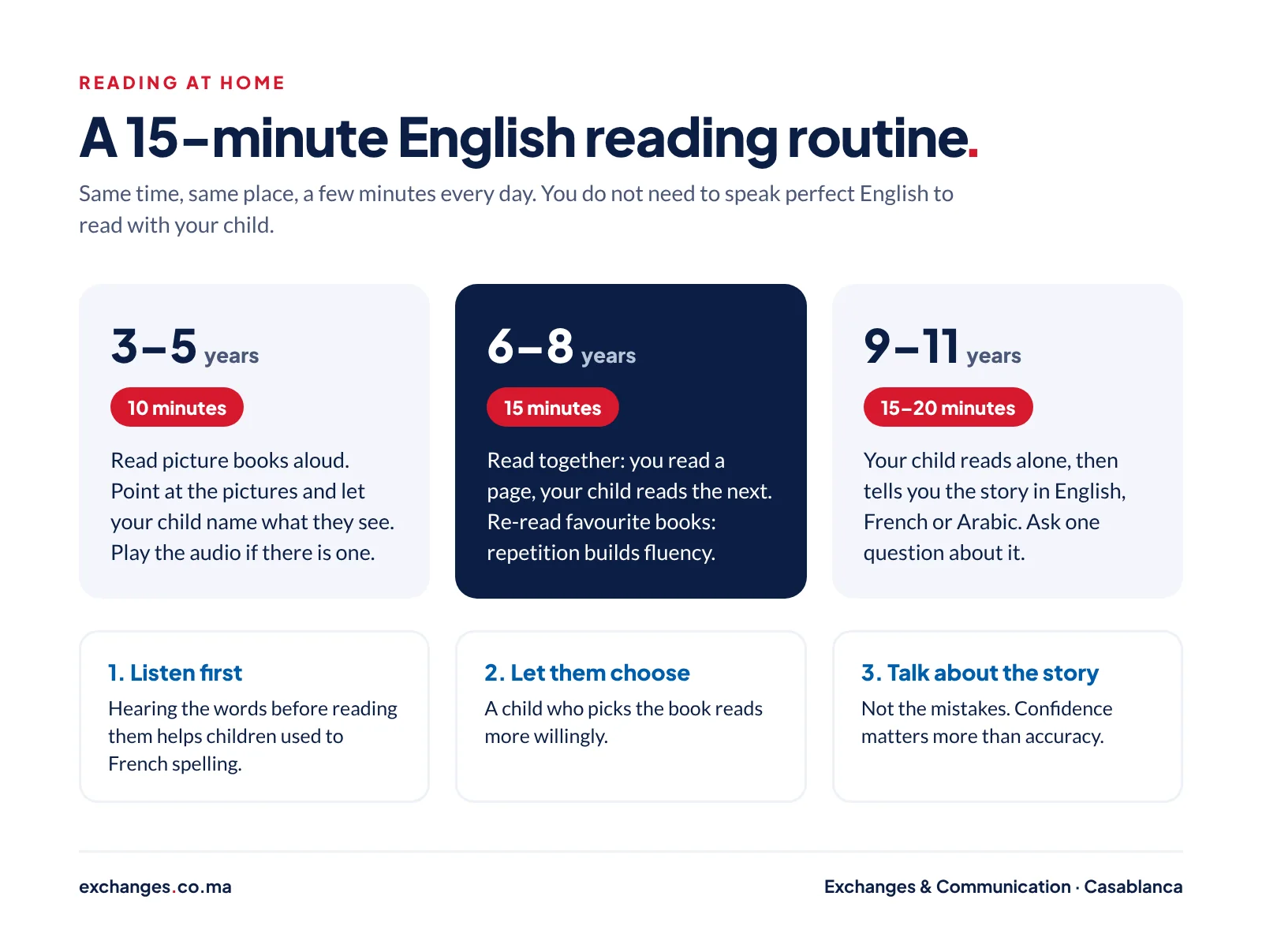
You do not need to speak perfect English to read with your child. What counts is the routine: same time, same place, a few minutes every day.
| Age | What to do | How long |
|---|---|---|
| 3 to 5 | Read picture books aloud, point at the pictures, let your child name what they see. Play the audio if the book has one. | 10 minutes |
| 6 to 8 | Read together: you read a page, your child reads the next. Re-read favourite books; repetition builds fluency. | 15 minutes |
| 9 to 11 | Your child reads alone, then tells you the story in English, French or Arabic. Ask one question about it. | 15 to 20 minutes |
Three habits make it work:
Choosing books
The best English books for kids are the ones they can almost read alone. A book that is too hard turns reading into decoding; one that is too easy teaches nothing new. That is what graded readers for young learners are made for: stories written at a controlled level, with limited new words per page, pictures that carry the meaning, and often an audio recording.
Most graded reader series follow the same levels as the Cambridge English exams for young learners, which go from Pre A1 Starters to A1 Movers and A2 Flyers.4 That makes it easy to match a book to what your child is learning at school.
When you choose a book, check four things:
Homework
Many parents in Morocco spend long evenings on homework. For young children, research suggests that is rarely worth it. Harris Cooper’s review of homework studies found little or no link between homework and achievement in primary school, while a small amount may help children build study habits.3 A guide by the US National PTA and National Education Association, cited in the same article, recommends 10 to 20 minutes a day for the youngest pupils.3
That is good news for English. Instead of a long worksheet session, try this:
Fifteen minutes with a book your child enjoys does more than an extra page of exercises.
In Casablanca
Looking for English books for kids in Casablanca? The Exchanges Bookshop in Bourgogne stocks graded readers for young learners from Cambridge, Pearson and National Geographic Learning, from Starters to Flyers level and beyond. Our team will help you find the right level for your child. We also run reading workshops and trainings: see the upcoming events.
Our team at the Exchanges Bookshop in Bourgogne will help you choose graded readers at the right level, from Starters to Flyers and beyond.
After thirty years working with Moroccan schools, our conviction is simple: children learn English by using it, not by studying rules about it. Reading for pleasure is the easiest way to give them that use at home. French is not in the way; it is the first bridge to English, and a child who reads in two languages is ready for a third.
Opinion of Exchanges & Communication.
Children can listen to English stories from 3 or 4. Most start reading simple English books around 6 or 7, once they read comfortably in their first school language.
No. Children who already read in one language transfer many skills to the next. Hearing the audio helps them avoid reading English with French sounds.
Storybooks written at a controlled language level, often with audio, so children can read with little help. Levels usually match the Cambridge Starters, Movers and Flyers exams.
At the Exchanges Bookshop in Bourgogne, where our team helps you choose the right level.
Our view · 19 Nov 2026
Why we believe children should meet grammar in stories, songs and real exchanges first, and what the research really says about explicit teaching.